


Z & C Purlin
What purlins do
Purlins are the horizontal members that span between rafters or trusses and carry the roof sheets. They transfer the load from the sheeting into the main frame. Get them wrong and the roof deflects, the sheets oil-can and creak, and fixings work loose over time.
Cold formed steel purlins, rolled from galvanised coil, have largely replaced hot rolled sections in shed construction. They are lighter for the same load capacity, they arrive cut to length and pre-punched, and they can be handled and bolted up without lifting equipment on smaller spans.
Z purlin and C purlin
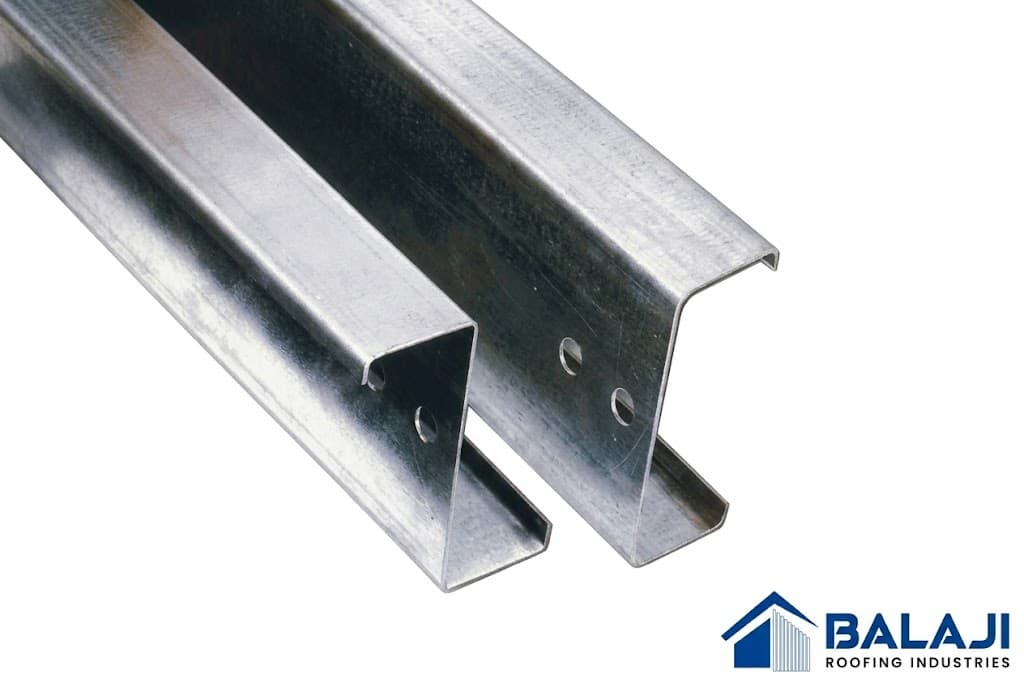
C purlins take their name from the section shape. Both flanges point the same way. They are used for shorter spans, for side rails in wall cladding, and as eaves and base members. They are simple to fix because they sit against the rafter with the open side accessible.
Z purlins have flanges pointing in opposite directions, and that is the whole point. The shape lets two purlins overlap at an internal support, so the run becomes continuous rather than a series of separate simply supported spans. A continuous run carries more load for the same section and deflects less, so on multi-bay buildings Z purlins let you either use a lighter section or increase the spacing between frames.
As a rough guide: C for single spans, side rails and secondary framing; Z for continuous multi-span roofs where the overlap can be used. On many buildings both appear, Z through the roof and C at the eaves and gables.
GI purlin and why galvanising matters
GI purlins are formed from galvanised coil, so the zinc coating is already on the steel before rolling. The alternative is fabricating from black steel and painting afterwards, which leaves every cut edge and bolt hole unprotected. Inside a closed shed that may be acceptable; in a humid, coastal or chemically loaded building it is where corrosion starts, out of sight above the sheeting.
Purlins are difficult and expensive to replace once a building is in use, because the roof has to come off to reach them. Specifying the coating properly at the start is far cheaper than dealing with it later.
Sizing, spacing and thickness
Three things drive the section: the span between frames, the spacing between purlins, and the load. Load is not just the sheet. It includes wind uplift, which on a light roof often governs the design rather than downward load, plus any services hung from the roof and the weight of a person during maintenance.
Purlin spacing and sheet thickness trade against each other. Wider spacing means fewer purlins but a thicker sheet to span between them. Closer spacing allows a thinner sheet. The economic answer depends on the relative price of the two on the day, which is worth actually checking rather than assuming.
Depth and thickness are separate decisions. Depth mostly governs deflection; thickness mostly governs strength and local buckling at supports. A deep thin section can be strong enough overall and still fail locally where the load concentrates.
Sag rods
Purlins are efficient in the direction they are loaded and weak sideways. On a sloping roof part of the load acts along the slope, which tries to twist and bend them laterally. Sag rods, also called purlin rods, tie the purlins together between frames and restrain that movement. On longer spans they are structural, not optional, and leaving them out is a common cause of visible purlin rotation and sheet distortion.
Ordering
Send the span between frames, the number of bays, the roof slope, the purlin spacing if it is already fixed, and the sheeting you plan to use. If you have a structural drawing, that answers everything at once. We supply cut to length with punching set out for your frame spacing, so material arrives ready to bolt up rather than needing site drilling.
Also known as
- Purlin
- C
- Z
- GI Purlin
Enquire about Z & C Purlin
Tell us the sizes and quantities you need. We will reply on WhatsApp.
Prefer to talk? +91 8008080609