


Roofing Accessories
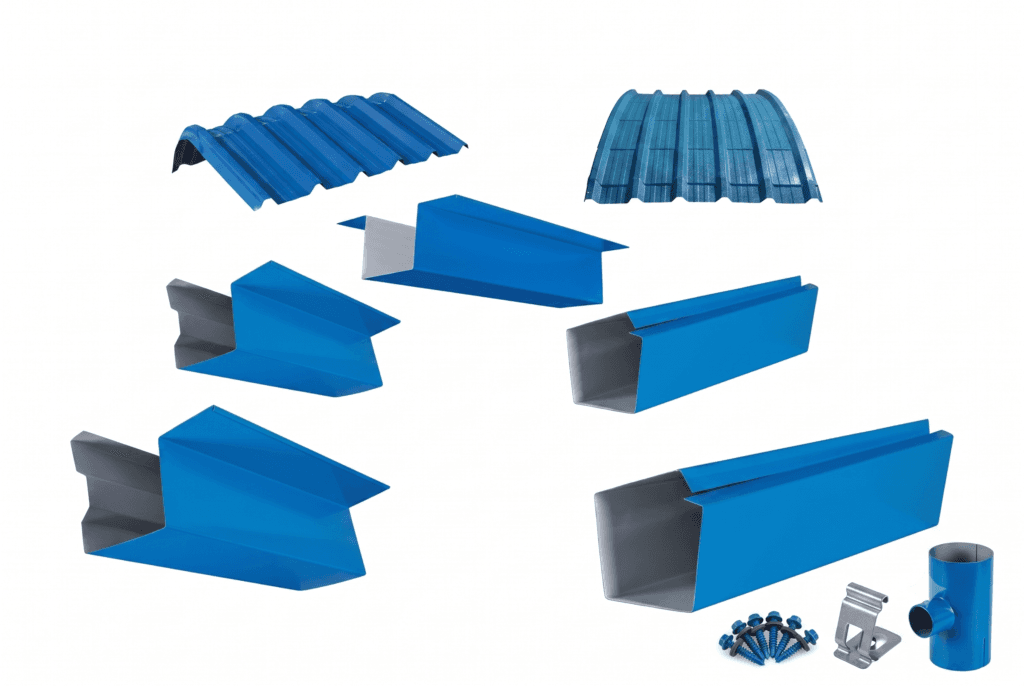
The parts that make a roof watertight
Sheets cover the middle of a roof. Everything else is done by the accessories, and almost every leak on an otherwise sound roof starts at one of them. Ridges, flashings, gutters and fasteners are where water is redirected, where two planes meet, and where the roof is penetrated. Those are the three places water gets in.
We fabricate and supply the full range in the same coating and colour as the roof sheets, which matters more than it sounds. Accessories ordered separately from a different supplier arrive in a different shade and a different coating grade, and the lower grade corrodes first.
Ridge and flashings
The profile ridge closes the apex where two roof slopes meet, pressed to match the sheet profile so it sits down on the corrugation instead of bridging it. A plain flat ridge over a profiled sheet leaves gaps at every rib, which is where wind driven rain and birds get in.
Flashing is the general term for a folded sheet that closes a junction. Each type has a job. L flashing closes a simple right angle. Apron flashing covers the joint where a roof meets a vertical wall. Gable flashing and barge board finish the sloping edge at the end of the building, and also stop wind lifting the edge sheet. Canopy flashing weathers the junction over a projecting canopy. Drip flashing throws water clear of the wall face instead of letting it run back down it.
Corner pieces and bending sheet cover the ad hoc junctions every real building throws up. We bend to the angle needed rather than forcing a stock profile into a joint it does not fit.
Rainwater goods
Eaves gutter catches water at the bottom of the slope, and is asked for locally as parnali or nali. The downtake pipe or downspout takes it to ground. The two most common faults are undersizing and underfalling. A gutter too small for the roof area overflows in heavy rain and sends water down the wall, and a gutter laid dead level holds standing water, silt and eventually plant growth.
Gutter size should follow the roof area draining into it and the rainfall the location actually sees. A monsoon region needs more capacity than a rainfall average suggests, because what matters is the intensity of the worst hour, not the annual total.
Dhapa covers the closure and capping pieces that finish an edge or a joint neatly and keep water and birds out of the void.
Crimped and curved work
Crimping compresses one edge of a profiled sheet so it can be curved. A crimping sheet or crimp curved sheet forms the arch on a curved roof, a canopy or a barrel vault without cutting and joining. Because the sheet stays continuous over the curve there are no laps along the run, which removes the leak points a faceted roof would have.
Screws and fasteners
The cheapest item on the roof decides how long the rest of it lasts. Self drilling screws fix through the sheet into the purlin in one operation. What matters is the washer and the coating. A bonded EPDM washer seals the hole; a plain washer does not, and the hole then leaks for the life of the building.
Coating grade has to match the sheet. Put an ordinary zinc plated screw into a galvalume or aluminium roof and the two metals react. Rust blooms around every fixing and streaks down the sheet, and the roof looks a decade older than it is within a couple of seasons.
Fixing position matters too. Screws go through the crown of the rib on most profiles, not the valley, so the fixing sits above the water path rather than in it.
Why order accessories with the sheets
Colour is batch dependent. Accessories rolled from the same coil as the roof match; accessories bought later from a different batch rarely do, and on a visible elevation the difference shows. Ordering together also means the coating grade is consistent across the whole roof, so nothing on it is a weak point waiting to corrode first.
What to send us
A drawing is ideal. Failing that, the roof area, the sheet profile and colour, the total length of ridge and eaves, the number of gable ends, and any junctions against walls or canopies. Photographs of the awkward corners are genuinely useful, because those are the pieces that have to be made to fit rather than picked off a list.
Also known as
- Dhapa
- Parnali
- Corner
- L Flashing
- Bending Sheet
- Gutter
- Downtake pipe
- Downspout
- Flashing
- Crimp
- Crimping Sheet
- Nali
- Barge Board
- Eaves Gutter
- Profile Ridge
- Ridge
- Drip Flashing
- Canopy Flashing
- Gable Flashing
- Apron Flashing
- Screws
- Fastener
Enquire about Roofing Accessories
Tell us the sizes and quantities you need. We will reply on WhatsApp.
Prefer to talk? +91 8008080609