


PUF Roof & Wall Panel
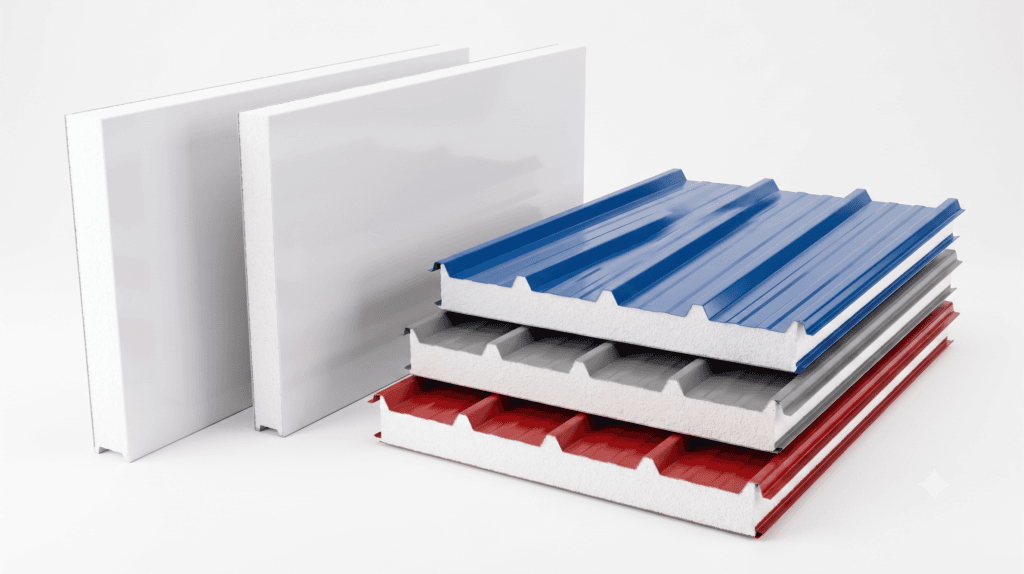
Insulation built into the panel
A PUF panel is a factory made sandwich: two metal skins with a rigid polyurethane foam core bonded between them. The foam is not a filler. Once bonded, the assembly acts structurally as one piece, so the panel spans further than either skin could alone while doing the insulation work at the same time.
That combination is why PUF panels dominate cold storage. One product gives structure, weather skin, vapour barrier and insulation, and it arrives finished. Building the same performance up in layers on site takes longer and leaves more places for a gap.
These are also sold as sandwich panels, composite panels, polyurethane sheet, PU sheets, foam sheet and double layer sheet.
Roof and wall panels
PUF roof panels are profiled on the outer skin to shed water and lapped so the joint sits above the water line. PUF wall panels are usually flat or lightly profiled with a concealed joint, because a wall does not need to drain and a clean face is worth more. Both use the same core; the difference is the skin and the joint.
Continuous PUF panels are made on a continuous line rather than pressed in discrete lengths. The process gives more consistent core density along the panel, which matters on long runs where a variable core would show as variable performance.
PUF, PIR and EPS
These get used interchangeably in conversation and they are not the same.
PUF is polyurethane foam. It has excellent insulation value per millimetre, which is why it is the default for cold rooms where every millimetre of wall thickness is floor area lost.
PIR is polyisocyanurate, a close relative made with a modified chemistry that gives it better behaviour when exposed to fire. Where fire performance is being specified rather than assumed, PIR is usually the panel being asked for.
EPS is expanded polystyrene: the familiar bead foam. It insulates less well per millimetre, so an EPS panel must be thicker for the same result, but it costs less and is entirely adequate for a partition or a non-refrigerated building.
The honest summary is that PUF and PIR buy thinner walls and better performance, EPS buys a lower price. Which is right depends on whether the wall thickness or the invoice matters more on that job.
Cold storage and thermal insulation
For cold storage panels the specification is driven by the temperature difference between inside and outside and by how continuously it runs. A chiller at a few degrees above zero and a freezer well below it are different problems, and the freezer needs considerably more core thickness.
The detail that decides whether a cold room performs is the joint. Panels lock together with a tongue and groove and a cam lock, and that joint has to be continuous and sealed. A thermal bridge at a joint or at a corner does not just leak a little cold; it condenses moisture, and over time water in the joint destroys the panel from inside. Corners, door frames and floor junctions are where this shows up first.
Heat resistant panels in hot process areas work the same way in reverse, keeping heat out of a controlled space rather than cold in.
What goes wrong
Core density is the number to ask about, and it is the one most easily reduced to hit a price. A lower density core insulates less and, more importantly, is weaker, so the panel spans less and dents more easily during handling.
Skin thickness is the second. A very thin outer skin oil-cans visibly on a flat wall panel and dents from ordinary knocks in a working building.
Site damage is the third, and it is the most common of all. A crushed edge is a permanent thermal bridge, and once panels are installed and sealed you cannot inspect the core. Panels should be lifted rather than dragged and stored flat and dry before fixing.
Sending an enquiry
The most useful information is the internal temperature you need to hold, the external conditions, the panel areas for roof and wall separately, and the span between supports. If it is cold storage, tell us the running temperature rather than the room’s name, because chiller and freezer specifications differ substantially. We will come back with core type and thickness to suit rather than defaulting to the thickest option.
Also known as
- PUF
- PUF Roof Panel
- PUF Wall Panel
- PUF Panel
- Sandwich Panel
- Polyurethane Sheet
- PU Sheets
- Foam Sheet
- PIR Panel
- EPS Panels
- Composite Panel
- Continuous PUF Panel
- Double Layer Sheet
- Cold Insulation Sheet
- Cold Storage Panels
- Thermal Insulation Panels
- Heat Resistant Panel
Enquire about PUF Roof & Wall Panel
Tell us the sizes and quantities you need. We will reply on WhatsApp.
Prefer to talk? +91 8008080609