


Polycarbonate Sheet
Updated
Fibre Sheet
Fibre Sheet
Fibre Sheets, commonly known as FRP Sheets, are reinforced plastic sheets designed for high strength, corrosion resistance, and durability. These sheets are widely used for industrial roofing, skylights, and cladding applications where chemical resistance and low maintenance are essential. Fibre sheets offer reliable performance in demanding industrial environments.
View DetailsMultiwall Polycarbonate Sheet
Multiwall Polycarbonate Sheet
Multiwall Polycarbonate Sheets are structured polycarbonate sheets with multiple internal layers that enhance thermal insulation while maintaining high light transmission. Their rigid yet lightweight design provides improved strength, energy efficiency, and noise reduction. Multiwall sheets are suitable for roofing, skylights, greenhouses, and architectural applications requiring insulation and durability
View Details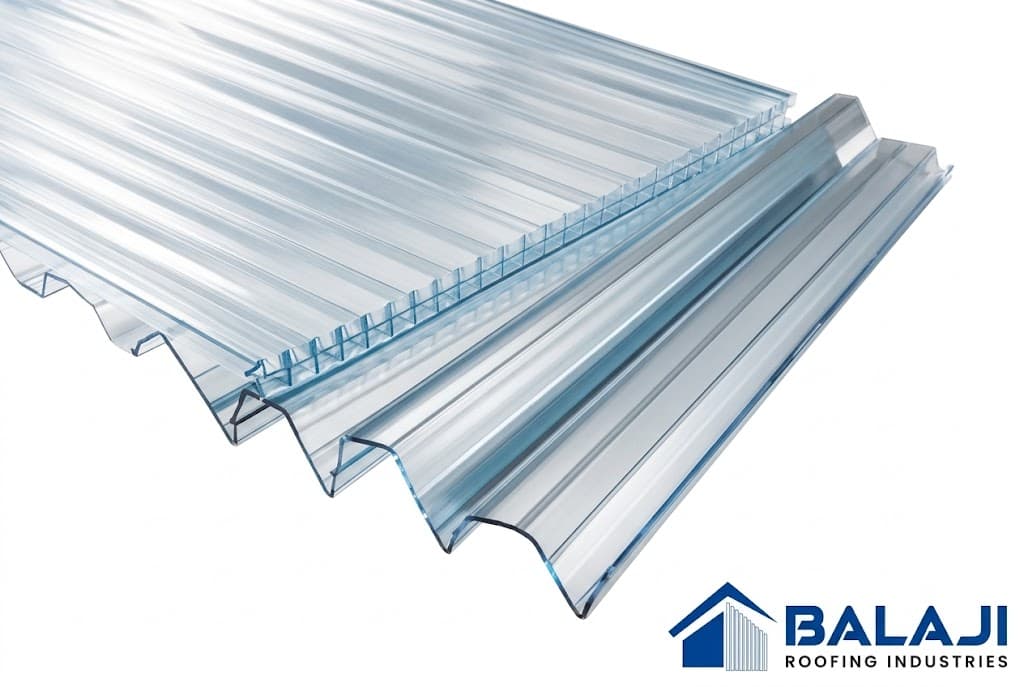
Polycarbonate Roofing Sheet
Polycarbonate Roofing Sheet
Polycarbonate Roofing Sheets are high-impact, lightweight sheets designed to provide excellent light transmission along with superior strength and weather resistance. These sheets are commonly used for skylights, walkways, canopies, and industrial roofing where natural daylight and durability are required. Polycarbonate roofing sheets offer long service life, UV protection, and easy installation.
View Details
About Polycarbonate Sheet
Roof light without a hole in the roof
Polycarbonate and fibre sheets let daylight into a building through the roof. On a shed with no roof lights the lights stay on all day. Replacing a proportion of the metal sheets with translucent ones in the same profile cuts that, and because the profile matches, the sheets lap into the surrounding roof without special detailing.
These get asked for under a lot of names: PC sheet, transparent sheet, light sheet, glass sheet, plastic sheet, and simply roof light.
What we supply
Polycarbonate roofing sheet is profiled to match standard metal roofing so it drops straight into the run. This is the ordinary industrial roof light.
Multiwall polycarbonate has two or more walls with air channels between them. The trapped air gives it far better insulation than a single skin, so it is used where light is wanted without the heat that usually comes with it. Also sold as multilayer sheet and, in coloured form, as coloured polycarbonate sheet. Solid or compact polycarbonate is the single skin version, used where clarity matters more than insulation.
Fibre sheet, also called FRP, is glass fibre reinforced plastic. It diffuses light rather than transmitting it clearly, which suits work areas where glare on a screen or a machine surface is a nuisance. It is generally the cheaper option per square foot.
Polycarbonate or FRP
Polycarbonate is much more impact resistant, which matters on roofs that get walked on for maintenance or that sit under trees. It also holds light transmission longer if it carries a UV protected surface. FRP costs less and diffuses light more evenly, but it tends to yellow and lose transmission earlier, and it becomes brittle with age.
If the sheet is somewhere people will step, polycarbonate is the safer specification regardless of price.
Getting the install right
Most polycarbonate failures on site are fixing failures. Plastic expands and contracts far more than steel across a day, so the holes must be oversized and the fasteners must let the sheet move. Screwing it down tight the way you would a metal sheet causes cracking around the fixings within a season or two.
UV protection is directional. The sheet has a treated face that must go upward. Fitted the wrong way up it degrades quickly, and this is a common and expensive site error.
Multiwall sheet needs its open flutes sealed at the ends, vented tape at the bottom and solid tape at the top, so water and dust cannot get into the channels. Unsealed flutes fill with algae and the sheet goes green from the inside.
How much roof light to plan for
There is no single correct proportion. Enough to work by, not so much that the building overheats. Spreading the sheets evenly across the roof gives more usable light than clustering them, because the aim is even coverage at working level rather than bright patches. Multiwall or diffusing sheet gives softer light than clear.
Sending an enquiry
Tell us the profile of the surrounding metal sheet, the run length, how many sheets or what percentage of the roof you want translucent, and whether the priority is maximum light or controlled light with less heat. If you are matching an existing roof, a photograph of the profile is usually enough for us to identify it.
Enquire about Polycarbonate Sheet
Tell us the sizes and quantities you need. We will reply on WhatsApp.
Prefer to talk? +91 8008080609